GGDB - Good Gamer's Database

Good Gamer’s Database — What Is GGDB and What’s It For?
visit this link: ggdb.pro
The gaming industry keeps growing faster than most predictions expect. GGDB is my attempt to fix a few things about that growth that I think are missing or built the wrong way. Here’s the short version:
- Build your own game library, see your own analytics
- Get your Gaming DNA
- Get pinpoint game recommendations
- Rate games with a 6-layer rating system
- Sourced, trustworthy game data
- Build a professional portfolio if you work in the industry
- Show your name on games through Cast & Crew
Let’s go through each one.
What GGDB Actually Is
GGDB isn’t a game database — it’s a database built for the player. You get to track your own data:
- Which games you played, and for how long
- Which genres you actually like
- What you were into and when, across your whole gaming life
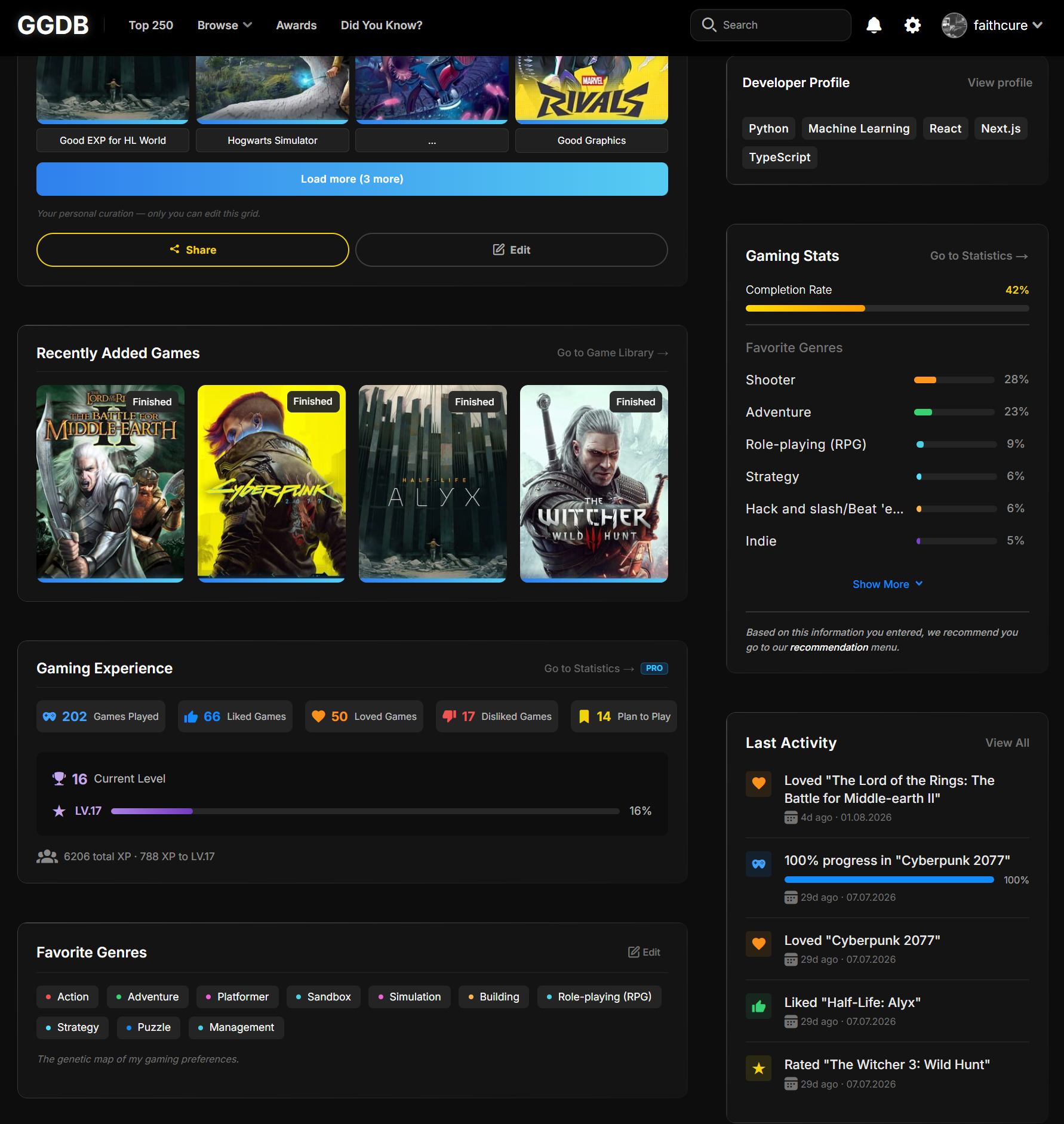
You can also put your best games on display for anyone visiting your profile, build out a grid, and follow your own history through analytics and charts.
Here’s how it works:
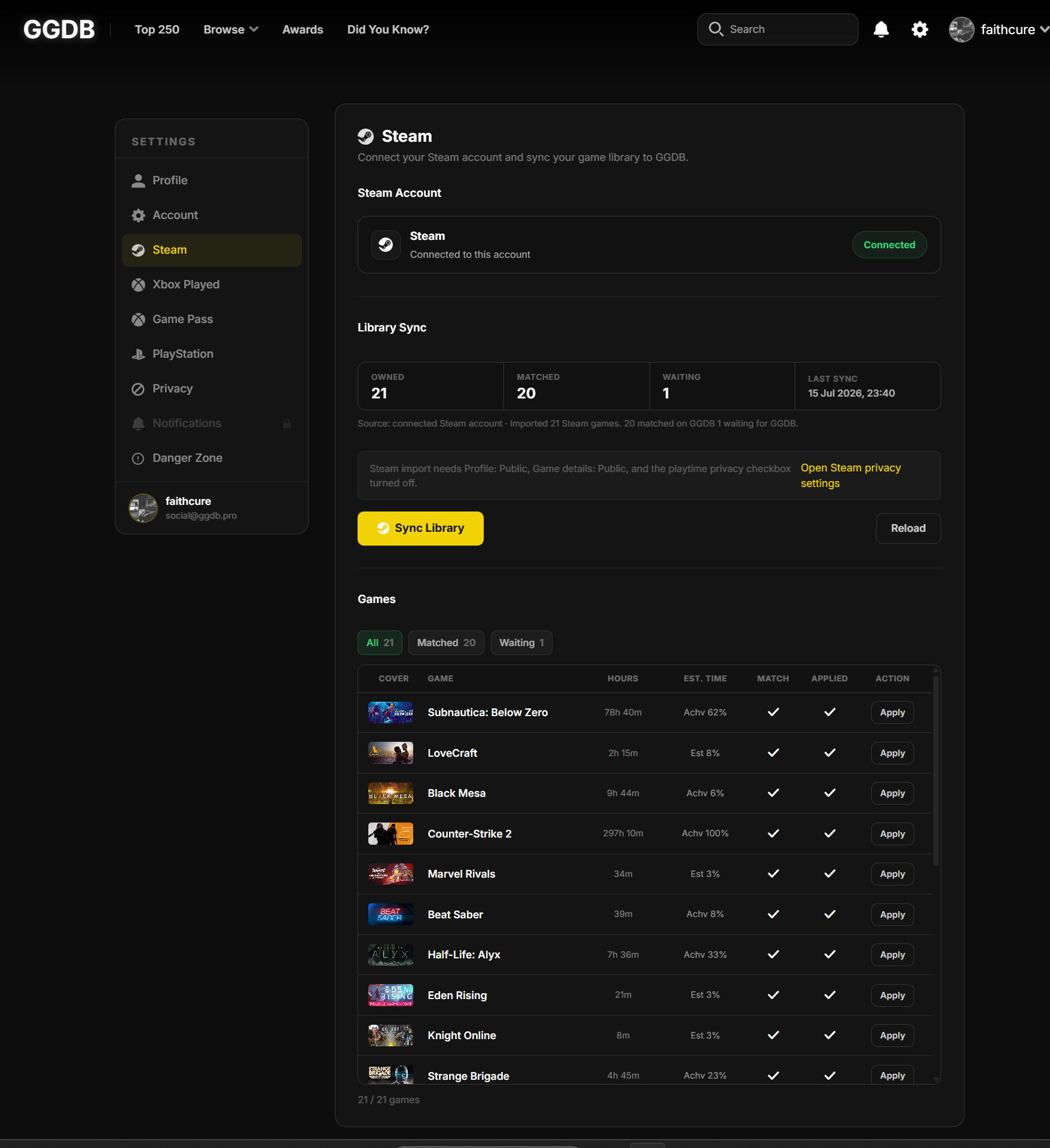
- Connect Steam, Xbox and PlayStation with one click, and GGDB pulls everything into your library
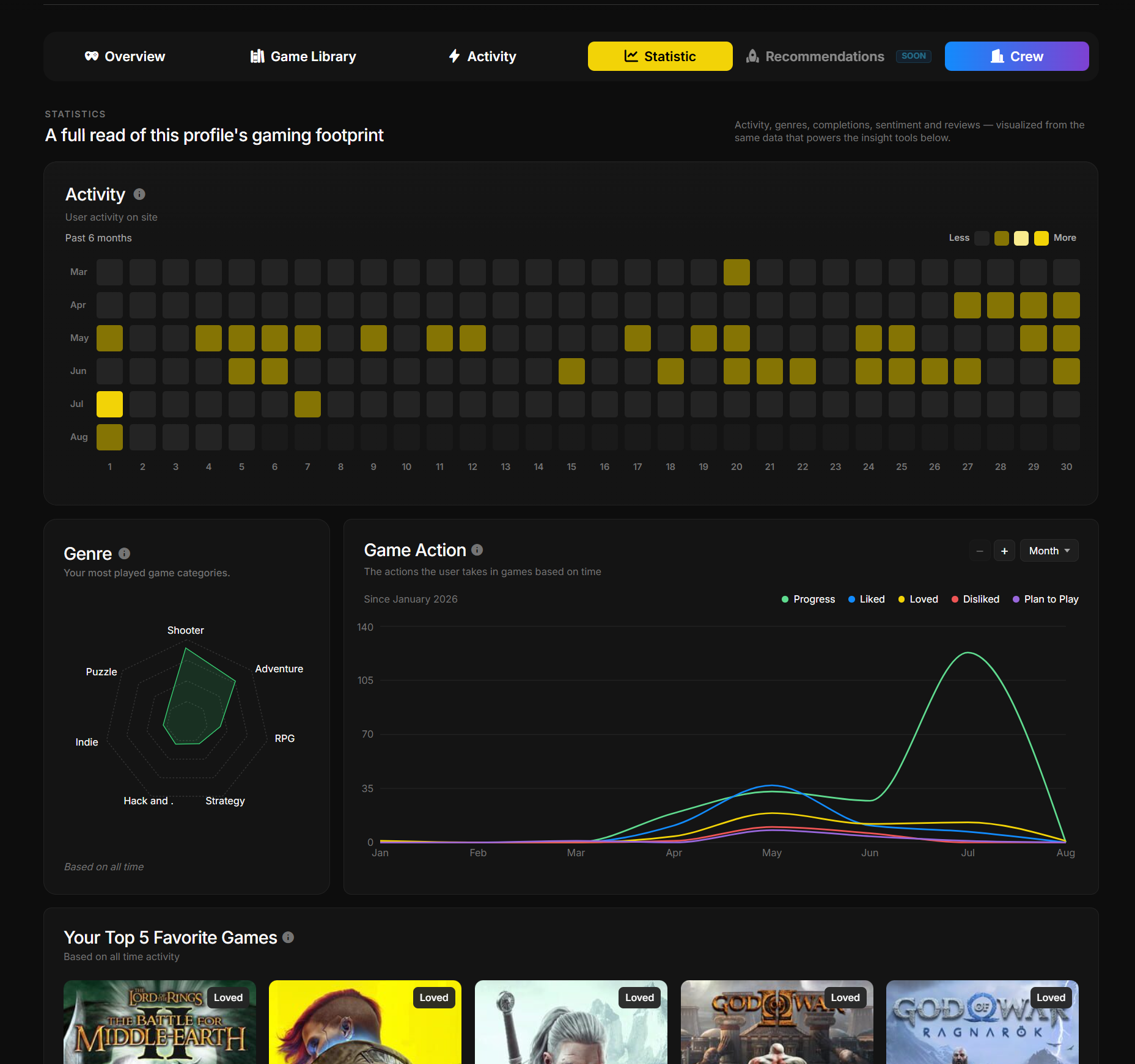
- You get detailed analytics based on that data
- A Netflix-style algorithm looks at your behavior and recommends games you’ll actually like
- That solves the “what’s next,” “what can I play right now,” “any suggestions?” problem
People already try to solve this socially — asking friends “anything like RDR2? Something similar to GTA?” — but those answers are mostly guesswork dressed up as advice. GGDB’s algorithm actually knows you, so the recommendation is precise. Someone who plays a lot of FPS games doesn’t automatically like every FPS game out there. (How we solve this technically is a story for another post.)
If You’re a Player
- Build your own game library
- Share your player profile wherever you want
- Find other players with similar taste
- Stop having your data scattered across five platforms — it all lives in one place
- The games you’ve played stop being wasted time and start being worth something
If You’re a Developer or Artist
- Build your portfolio
- Credit yourself on a game, and your “Crew” tab lights up on your profile
- One link is all you need to send to a studio when you apply
- Unlike ArtStation or Behance, this space is built specifically for games — nothing generic about it

Six-Layer Ratings
Every other site makes you boil a game down to one score. We split it into six:
- Graphics
- Music & sound
- Story & writing
- Bugs & stability
- Gameplay
- (and more)
That’s how a game’s actual quality comes through — instead of getting flattened into a number that doesn’t tell you anything.

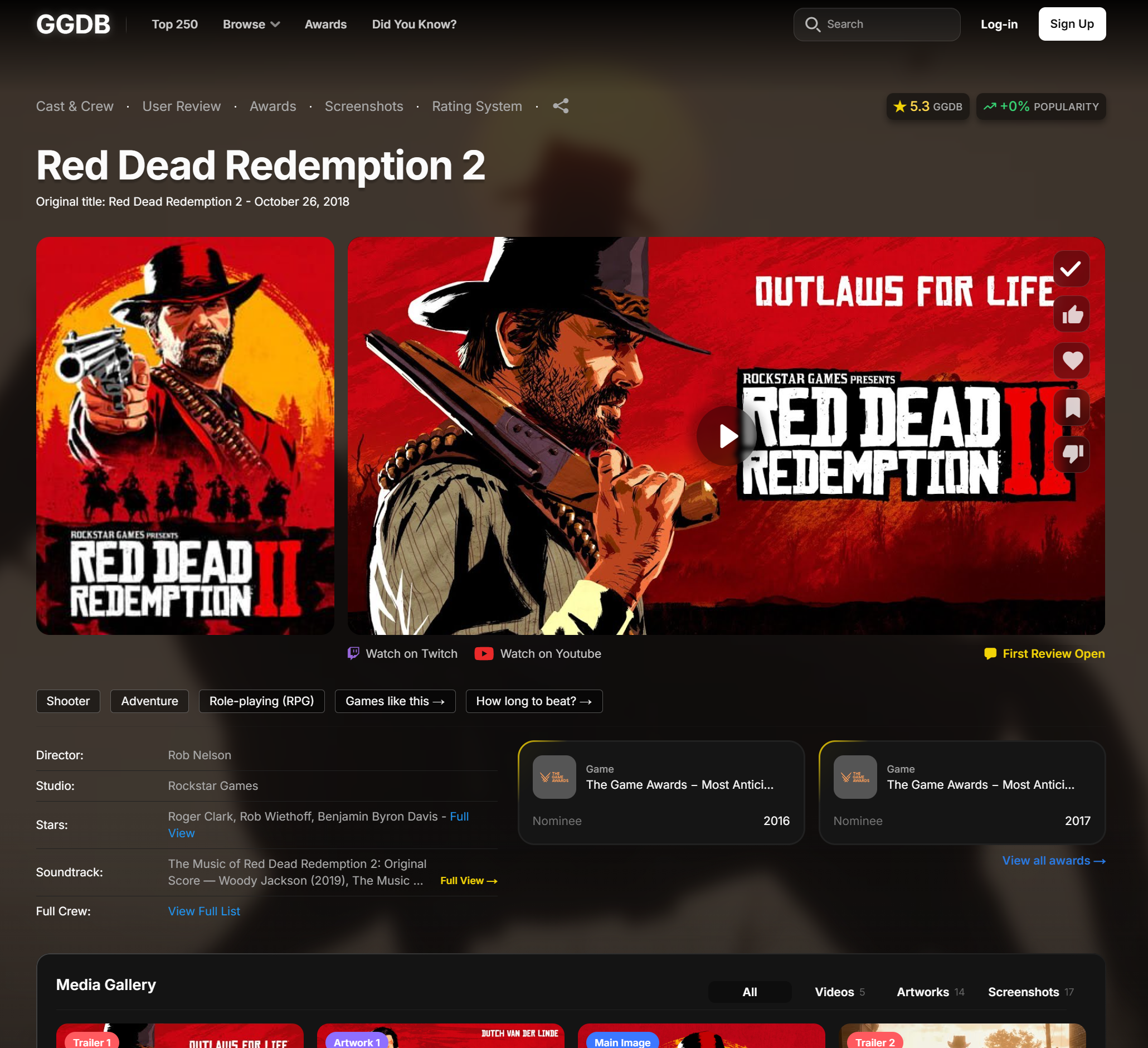
Game Details
We’re not a game database — there’s already plenty of those online, they’re just scattered or incomplete. What we do is pull that information into one interface, cite where it came from, and do it legally. We always show which source a piece of data came from. Nothing is made up.
What you’ll find on a game page:
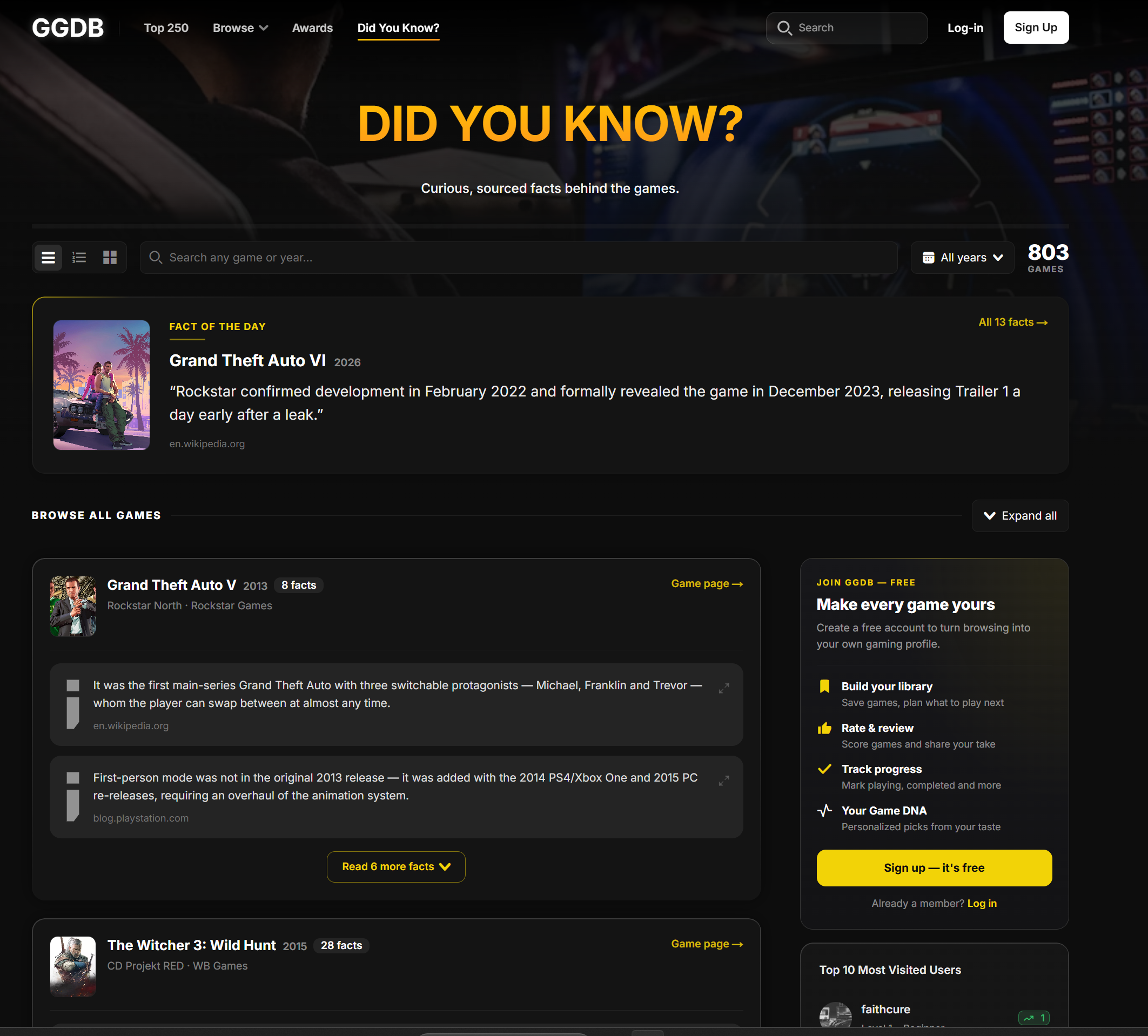
- Trivia and facts (sourced)
- Reviews and popularity
- Metadata, budget, revenue
- Time to beat
- Awards
Some of it can be improved through user contributions; most of it is static and locked.
Right now the platform has around 4,000 main games indexed, plus close to 17,000 pieces of sub-content — DLC, expansions, and similar.
Analytics
- You choose what to share and what to keep private
- You see your own patterns, follow your history however you like
- You discover things about your own taste you didn’t know

>i class="bz" loading="lazy">Based on what you’ve added, the system surfaces games you’re likely to enjoy. (For the most accurate results, pulling directly from Steam and PlayStation helps.) Every game page shows you a personal recommendation score, built from:
- How much of the game you’ve played (progress %)
- Whether you liked it (based on your in-app actions)
- How much time you spend on that game’s page (with anomalies filtered out)
- Your general behavior and connected platforms
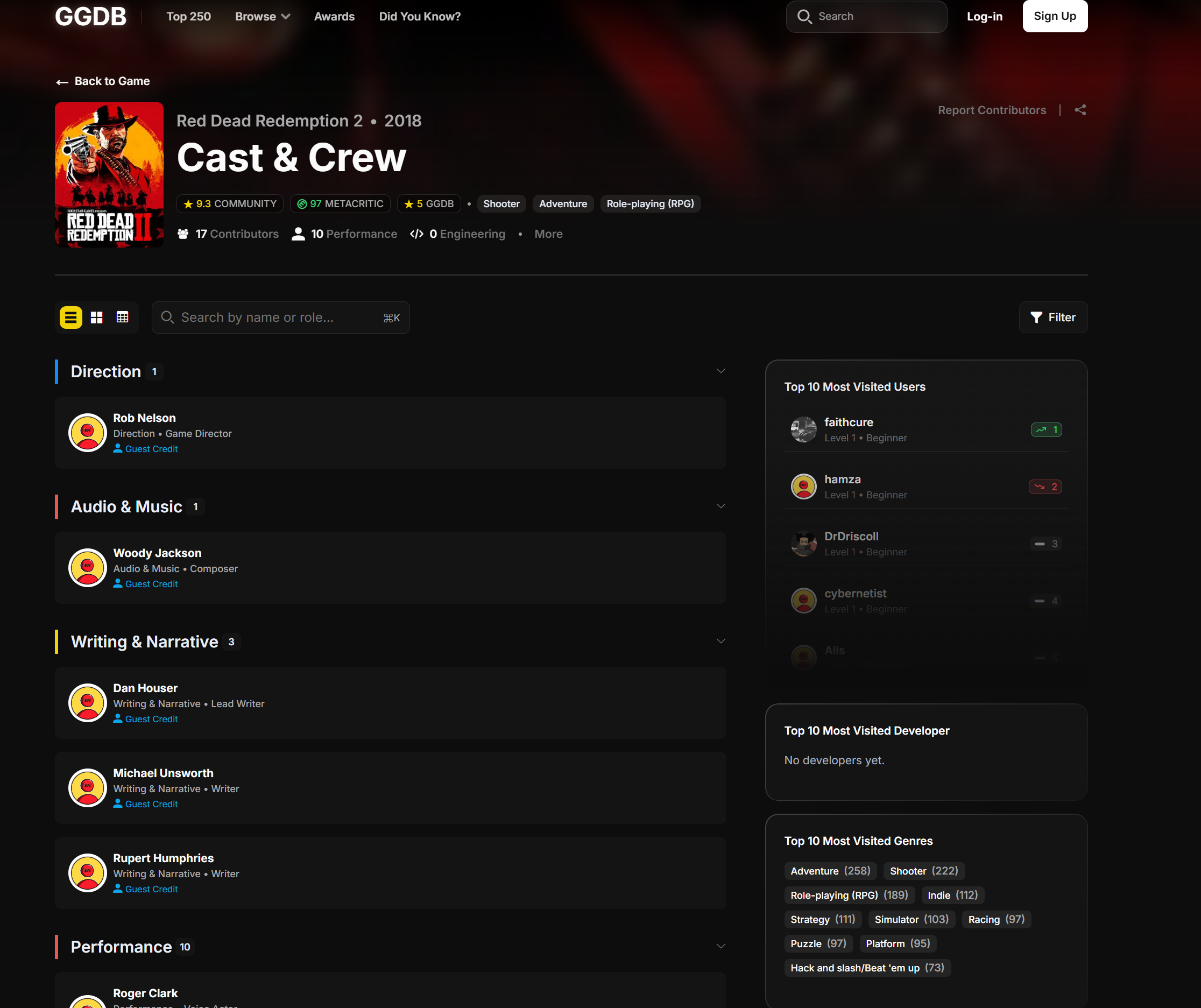
Cast & Crew — the Credits System
- The moment you tag yourself on a game, your name shows up on that game’s page — built on the same logic as IMDb
- You get to present your work in a serious, organized way
- Your visibility goes up
- We don’t sell this data

Why Sign Up?
- Sign up, complete your profile, connect your Steam/PlayStation/Xbox library
- Your Gaming DNA is ready within minutes
- The analytics take a little longer to build — the more you use it, the sharper it gets
- Discover players with a DNA close to yours (follow/friend system coming soon)
- Share your Gaming DNA anywhere, with a design that actually looks good
- If you’re a developer: share your profile directly in interviews, link ArtStation or Behance alongside it
- If you’re hiring, running a studio, or looking for teammates: browse portfolios and find the right person
XP and Levels
- Every action on the platform earns you points
- Progress gets harder the higher your level
- Real reviews, how many games you’ve finished, profile completion — it’s all factored in
- Level-based perks are something we’re planning to add soon

Badges
Another type of reward is badges. Right now they’re assigned by a deterministic system (AI-driven down the line), summing up your behavior in a single line. Take a look — does it match how you’d describe yourself?

What We’re Doing With AI
- No part of this — design, frontend, backend, database — was built with “vibe coding.” The architecture and logic are ours
- We use AI regularly for editing code and testing
- We’re testing AI agents across every part of the project
- A lot of human error that creeps into organically-entered data has been caught and cut down thanks to AI
- Work that used to take other sites years, we’ve been able to do in a fraction of the time, with far fewer mistakes
- We’ll keep expanding where AI is used, carefully and within safe limits
Building With Our Users
We built the core product ourselves, but we’re going to keep shaping it around the feedback we get. Whatever gaming communities actually need is what gets built next.
We’re early. But it’s a good place to be early from. Come be part of it — your comments and ideas matter to me. Talk soon.